The Rare-Earth Trade Is Becoming a Federal Deal Desk
A new cross-agency funding funnel may accelerate domestic projects, but capital still has to survive the brutal middle between ore and bankable output.
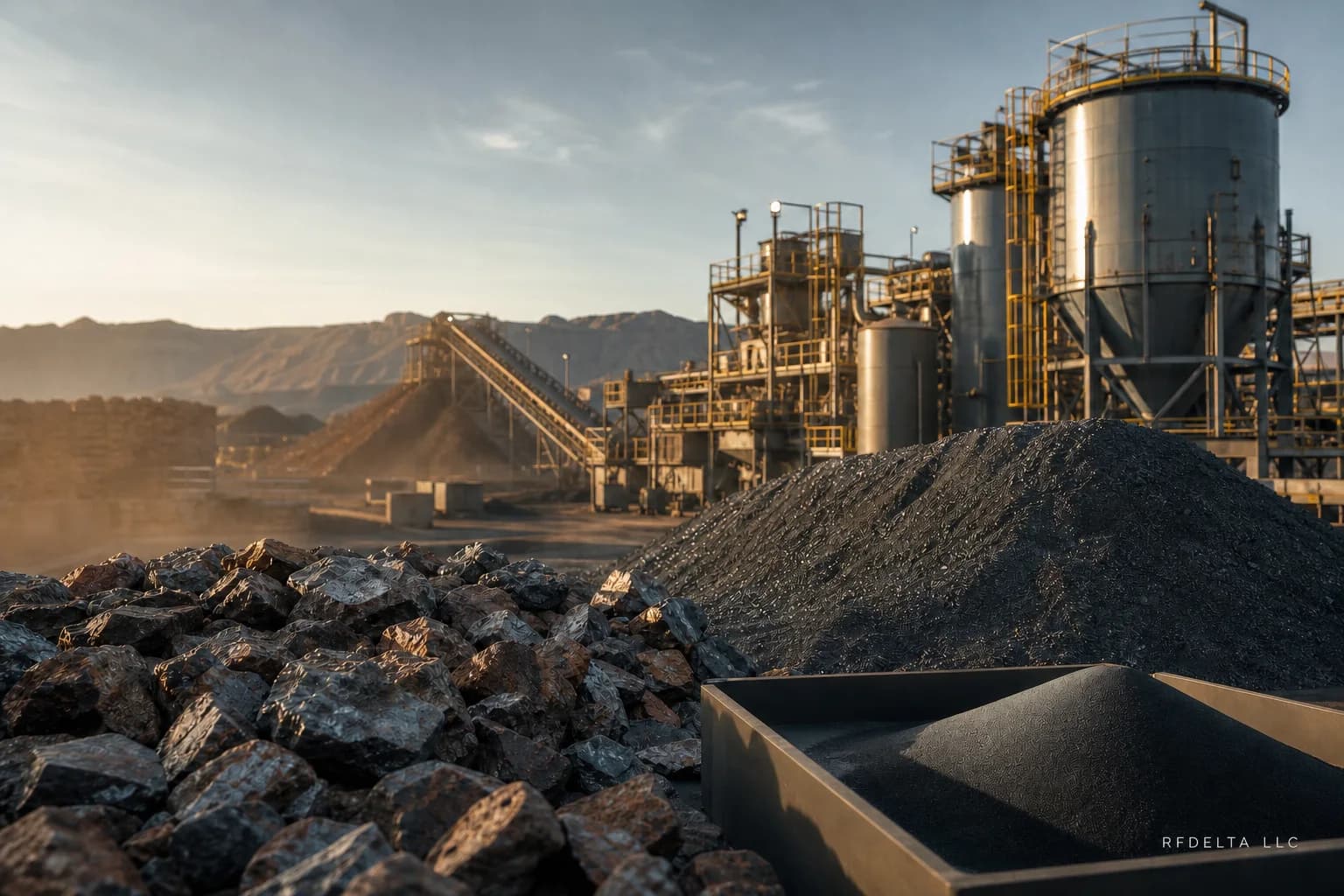 Original artwork · RFDELTA LLC
Washington is building a more coordinated path for critical-mineral projects, shifting the market debate from resource discovery to processing, offtake, and execution.
A single front door for a fragmented capital stack
The Department of Energy's new Common Investment Initial Screening Application looks administrative at first glance. In market terms, it is more consequential: one application is designed to connect eligible critical-mineral projects with opportunities across fourteen federal partners. The government is trying to reduce the friction between a project developer and the scattered grants, loans, procurement authorities, and strategic mandates that could finance it.
That is an acknowledgment of how awkward the sector has become. The United States does not simply need more geological prospects. It needs projects that can move from resource definition through permitting, pilot processing, commercial separation, customer qualification, and dependable production. Each stage attracts different capital, and a failure at any stage can strand everything upstream of it.
The headline shortage is not the investable shortage
Rare earths and other critical materials are often discussed as if scarcity begins and ends in the ground. The official funding record tells a different story. Energy Department awards emphasize pilot-scale processing, recovery, separation, efficiency, alternatives, and recycling. Those categories exist because a deposit is not supply until someone can turn it into material that a manufacturer will accept at a competitive price.
The agency's own program materials cite heavy foreign dependence for rare earth elements and numerous critical minerals. That dependency creates strategic urgency, but urgency does not repeal metallurgy. Separation plants must handle variable feedstock, meet purity standards, manage waste, and compete against established international producers whose costs and pricing behavior can change before a domestic plant reaches steady state.
Government support can accelerate a project—and expose it
A coordinated federal funnel should help serious developers identify the right capital earlier. It should also make weak projects easier to identify. Agencies can compare technical readiness, domestic content, offtake quality, and the credibility of cost estimates across a wider field. The result may be fewer promotional stories and more milestone-based financing.
That discipline is healthy, but it can be uncomfortable for public-market narratives built around optionality. Government selection does not guarantee a profitable mine, an economical refinery, or a favorable financing package for existing shareholders. Negotiation, matching funds, environmental review, and customer qualification still sit between an announcement and cash flow.
The middle of the chain may capture the first durable margins
The most interesting exposure may not be the largest resource. It may be the equipment, process, reagent, testing, and recycling capability used across many resources. A miner is tied to one geology and one capital structure. A proven processing technology or specialized engineering provider can participate across several projects and be paid before commodity-price upside is fully realized.
This is the picks-and-shovels argument with an important caveat: not every technical solution scales. Pilot plants often perform under controlled conditions that commercial facilities cannot reproduce cheaply. Investors should demand evidence of throughput, recovery, product quality, operating cost, and customer acceptance—not simply a laboratory result with a strategic label.
Strategic value and market value are different prices
A government may rationally support capacity that the spot market would not finance because the cost of being cut off during a crisis is larger than the subsidy. That strategic insurance value belongs to the country. It does not automatically belong to common shareholders. The mechanism used to preserve capacity determines who receives the benefit and who carries the downside.
A loan can improve a project's cost of capital while increasing fixed obligations. A grant can reduce construction cost but require matching funds. A purchase agreement can stabilize revenue but cap upside. Equity investors need to trace the policy support through the actual capital stack instead of treating every public dollar as an unrestricted transfer to the listed company.
Qualification is the quiet commercial gate
Customers in aerospace, defense, semiconductors, and advanced manufacturing do not substitute critical materials casually. A new producer may need repeated sample campaigns, process audits, reliability testing, and changes to customer designs before it becomes an approved supplier. That work can continue long after a plant proves it can make material at specification.
The qualification period creates working-capital pressure and delays utilization. It also creates a moat once completed. Producers that disclose the number and stage of customer qualifications offer more useful evidence than those announcing broad demand. A signed evaluation agreement is not the same as an approved part number, and neither is the same as recurring volume.
Recycling helps resilience but does not abolish mining
Recycling is attractive because it can shorten supply chains and recover high-value material from known products. It is also constrained by collection rates, product design, contamination, and the time required for installed goods to return as scrap. Fast-growing markets often need more material than the current waste stream can supply.
The better investment case is complementary rather than ideological. Recycling can provide a lower-risk domestic feed, reduce exposure to imported concentrate, and smooth production while primary projects scale. Technologies that accept multiple feedstocks may have more durable utilization than facilities built around one narrow waste source or one mine whose development schedule remains uncertain.
China still influences the clearing price
Domestic policy can underwrite capacity, but global supply still influences the price at which that capacity must operate. An established foreign producer can respond to new Western investment with lower prices, higher output, export restrictions, or preferential terms for downstream manufacturers. Each response changes the economics of a project whose construction budget was fixed years earlier.
That is why offtake design matters. Floor prices, cost sharing, purchase commitments, and strategic stockpiles can stabilize a project more effectively than a one-time grant. The policy question is no longer whether critical minerals matter. It is who absorbs the commodity risk required to maintain capacity when the spot market says it is temporarily uneconomic.
A useful skepticism for the next funding cycle
The federal deal desk makes the sector more investable by improving coordination. It does not make every participant investment grade. The strongest projects will be able to explain their feedstock, process, energy requirement, environmental obligations, customer specification, financing stack, and downside case in the same document.
The weakest will continue to sell scarcity without demonstrating conversion. In a market crowded with strategic language, the hard numbers remain stubbornly old fashioned: recoveries, unit costs, capital intensity, dilution, and time to qualified output.
Milestones
Favor projects that disclose pilot throughput, recovery rates, product specifications, and customer qualification progress.
Capital structure
Model matching-fund requirements and future dilution instead of treating a federal selection as fully funded construction.
Offtake protection
Look for price floors, long commitments, or strategic purchasing that can survive a hostile commodity cycle.
Read the reporting and records
- Department of Energy — Common Investment Initial Screening Application
- Department of Energy — Critical Material Innovation, Efficiency, and Alternatives
- Department of Energy — Critical Minerals and Materials Program
- Government Accountability Office — Foreign supplier dependence in the defense industrial base
This article interprets public records for a general audience. It is not investment advice, a recommendation to trade, or a prediction of any security's performance.
More market analysis
A Workforce Bet Joins America’s Critical-Minerals Push
A DOE Notice of Intent for up to $100 million shifts the critical-minerals debate toward the workforce needed to turn capacity plans into output.
Read the analysisClinical Wearables Face Their Evidence Test
Wearables can widen the clinical view, but accuracy, intended use, workflow integration and evidence will determine durable adoption.
Read the analysisTraCSS Is Moving From Service Launch to Operator Onboarding
TraCSS is moving closer to operators, making adoption, data quality and commercial differentiation central to the economics of orbital safety.
Read the analysis