The AI Boom Has Reached the Power Meter
Washington's newest compute campuses make one thing clear: the next leg of the AI trade is as much about substations, turbines, and permits as chips.
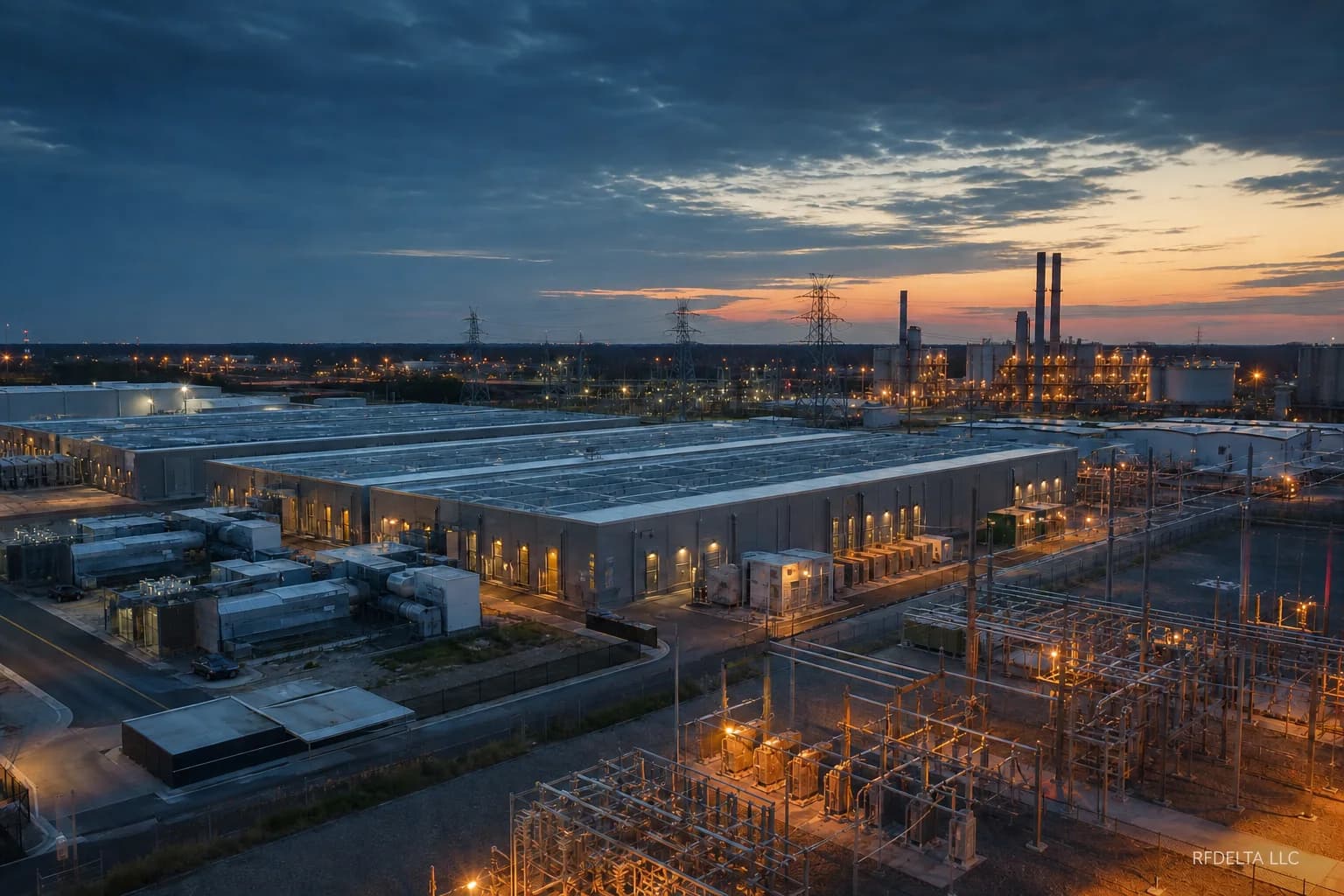 Original artwork · RFDELTA LLC
Federal AI-campus announcements are shifting the compute trade toward electricity, transmission, cooling, construction, and long-duration infrastructure risk.
The trade is leaving the server room
The market spent the first phase of the artificial-intelligence buildout counting accelerators. The next phase will be counted in megawatts, interconnection studies, transformers, cooling loops, construction crews, and years of permitting. That is a less glamorous ledger, but it is the one that increasingly determines whether announced compute capacity becomes an operating asset or remains a press release.
Recent federal announcements make the shift unusually visible. The Department of Energy described a proposed Western Kentucky redevelopment as a privately funded data-center and energy campus exceeding $100 billion. At the Savannah River Site, the National Nuclear Security Administration selected a counterparty to negotiate a phased lease for a proposed one-gigawatt AI data center paired with dedicated generation. These are not ordinary cloud expansions. They are industrial campuses designed around power from the opening blueprint.
Power is the scarce input hiding in plain sight
A chip can be ordered in a quarter. A transmission line, large substation, gas interconnection, or new generating unit lives on a different clock. The Department of Energy's draft 2026 National Transmission Needs Study points directly at load growth from data centers, manufacturing, and other large industrial users as a reason additional transmission is needed. That converts a technology demand curve into a regulated-infrastructure queue.
The distinction matters for investors because scarcity rents tend to migrate toward the slowest replaceable input. If accelerator supply improves faster than grid capacity, the incremental value of another chip can fall while the value of an energized site rises. Land with transmission access, power equipment with long lead times, and engineering teams capable of completing interconnections become part of the compute stack whether technology analysts include them or not.
Federal land is becoming an industrial-policy instrument
The federal-site model also changes the political economy of data centers. Existing government land can consolidate environmental review, security planning, utility coordination, and large-scale redevelopment into one negotiation. It can also tie private capital to broader public objectives, from regional power additions to national-security computing. That does not remove execution risk; it concentrates it in a smaller number of very large projects.
This approach may reward developers that can finance both sides of the meter. A campus is more credible when generation, storage, transmission, and cooling are financed alongside the data halls. The weak version of the AI-infrastructure story sells square footage. The stronger version delivers reliable energy, resilient operations, and a path through regulatory bottlenecks.
The grid can push back
Large AI facilities are not only big loads; they can be dynamic loads. Energy officials have highlighted the need to monitor oscillations created by synchronized computing demand, which may interact with nearby power equipment. That introduces a new class of engineering cost. Grid operators will care about ramping behavior, power quality, backup generation, and the ability to curtail or isolate a campus—not merely its annual electricity consumption.
The consequence is a tougher underwriting standard. A project that looks attractive at the level of annual megawatt-hours can be problematic at the level of second-by-second grid behavior. Equipment suppliers and developers that can demonstrate stability, controllability, and closed-loop operating discipline should be better positioned than those relying on optimistic demand projections alone.
The financing clock does not match the technology clock
Infrastructure lenders prefer long contracts, strong counterparties, predictable construction budgets, and equipment with established operating histories. AI customers live in a market where models, chips, and competitive positioning can change in months. Bridging those clocks requires agreements that make demand credible for long enough to finance assets whose useful life may extend for decades.
That puts unusual weight on contract structure. Minimum payments, credit support, termination rights, power-cost pass-throughs, and obligations after a technology refresh can determine whether a campus is bankable. A huge headline commitment is less valuable than a smaller load backed by a counterparty willing to pay through the construction and ramp period.
Transformers and trades can matter more than architectural renderings
The physical buildout also competes for specialized labor and equipment with utilities, factories, renewable projects, and ordinary grid maintenance. Large transformers, switchgear, turbines, and high-voltage components are not interchangeable catalog items. Designs must be frozen, manufacturing slots secured, and crews coordinated around outages and interconnection milestones.
This creates a difference between announced capacity and executable capacity. Developers with procurement teams, standardized designs, repeat contractor relationships, and reserved equipment can move faster than newcomers even when both control attractive land. The moat is operational memory: knowing which drawings, permits, suppliers, and commissioning tests actually delay energization.
AI power is a regional basis trade
National estimates can obscure the local market. One region may have cheap generation but no transmission headroom. Another may have an available substation but expensive peak power. A third may face water constraints, gas-delivery limitations, or public opposition to new lines. The economics of compute therefore depend on a regional basis spread that combines energy price, congestion, construction cost, taxes, and time.
That basis can change before a campus opens. New industrial loads can tighten a formerly loose market, while transmission upgrades can relieve a premium location. Investors should follow interconnection queues, utility resource plans, regional capacity prices, and large-load tariffs. They are becoming early indicators for the geography of future computing margins.
Where pricing power may settle
The obvious beneficiaries are not automatically the best beneficiaries. Commodity exposure can be diluted by construction inflation. Regulated utilities can win load growth while absorbing political pressure over ratepayer costs. Data-center developers can hold scarce sites while carrying financing risk for years. The cleanest pricing power may sit with businesses that solve hard bottlenecks repeatedly: switchgear, transformers, power controls, cooling, grid studies, generation services, and specialized engineering.
The contrarian read is that the AI boom may eventually resemble an old-economy capital cycle. Capacity announcements attract capital, capital creates shortages, shortages lift margins, and elevated margins invite new supply. The winners will be those paid during the buildout without assuming that every announced campus reaches full utilization.
What would invalidate the thesis
The infrastructure thesis weakens if model efficiency reduces power demand faster than new uses absorb it, if data-center customers refuse long commitments, or if financing costs make dedicated generation uneconomic. It also weakens if transmission expansion accelerates enough to erase site scarcity. None of those outcomes is impossible.
For now, the official record points in the opposite direction: larger campuses, explicit generation plans, and a federal transmission study centered on new load. The market can debate which model wins. The grid has already begun pricing the physical consequences of the race.
Power equipment
Watch transformer, switchgear, substation, and control-system lead times rather than headline data-center square footage.
Utility regulation
Track who pays for transmission and generation upgrades, especially where public officials promise ratepayer protection.
Project quality
Separate sites with contracted power and credible counterparties from projects that have land but no executable energy plan.
Read the reporting and records
This article interprets public records for a general audience. It is not investment advice, a recommendation to trade, or a prediction of any security's performance.
More market analysis
A Workforce Bet Joins America’s Critical-Minerals Push
A DOE Notice of Intent for up to $100 million shifts the critical-minerals debate toward the workforce needed to turn capacity plans into output.
Read the analysisClinical Wearables Face Their Evidence Test
Wearables can widen the clinical view, but accuracy, intended use, workflow integration and evidence will determine durable adoption.
Read the analysisTraCSS Is Moving From Service Launch to Operator Onboarding
TraCSS is moving closer to operators, making adoption, data quality and commercial differentiation central to the economics of orbital safety.
Read the analysis